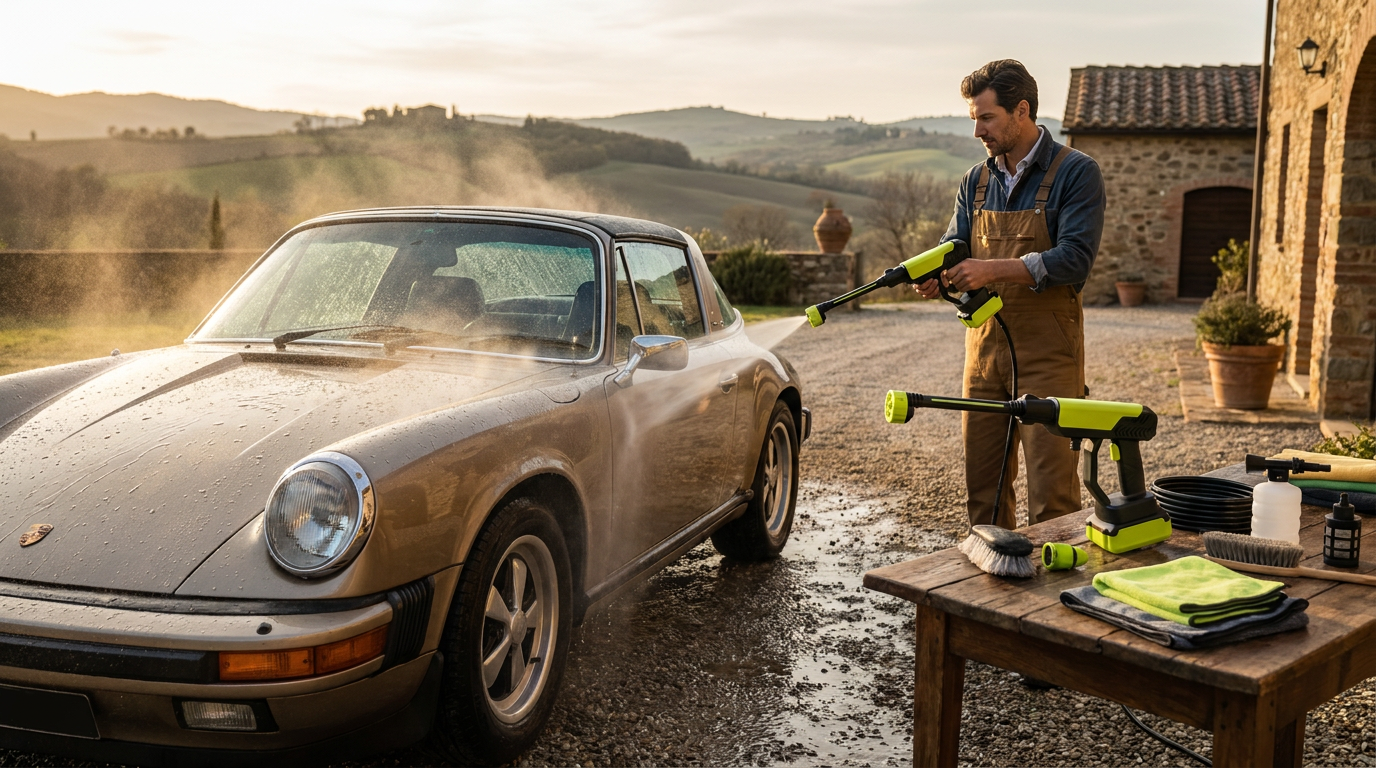
Optimizing Cordless Pressure Washers for Vehicle Detailing
 Maya ChenContributing Editor
June 20, 2026. This analysis evaluates the technical viability of battery-powered cleaning systems for automotive detailing. It is written for car enthusiasts and professional detailers who require mobility without sacrificing paint safety.
The Efficiency Gap in Portable Detailing
The conventional wisdom says that more PSI always equals a better clean, but for automotive paint, volume and control are the actual metrics of success. High-pressure gas units often risk delaminating clear coats or damaging sensitive sensors found in modern bumpers. According to Car and Driver, testing reveals that even compact electric units like the Ryobi 1900psi model provide a safer, more consistent output for vehicle surfaces than overpowered industrial alternatives. The problem for the mobile detailer, however, is the umbilical cord of a power outlet. Most detailers waste fifteen minutes per vehicle managing extension cords and water lines. When you run the math, that is nearly two hours of lost billable time over an eight-car day. Here's the part nobody talks about: the setup friction of traditional units often leads detailers to skip the critical pre-rinse phase, which is exactly when swirl marks are introduced to the paint. Moving to a system that functions as a pressure washer that pulls from a bucket eliminates the search for a spigot, but it also demands a disciplined look at battery life and flow rates.
Battery Architecture and Flow Dynamics

Photo by Tima Miroshnichenko on Pexels
Cordless Pressure Washers solve the mobility crisis by decoupling the pump from the grid, but the trade-off is often found in the Gallons Per Minute (GPM) rating. Most entry-level handheld units struggle to maintain the 1.2 GPM required to effectively flush abrasive grit from a vehicle's surface. However, the hardware has shifted. The Drive notes that the Ryobi 40V Brushless Whisper Series has emerged as a high-performance option for those needing sustained power without the noise pollution of a gas engine. This is particularly relevant for those using a cordless pressure washer for apartment balcony cleaning or driveway detailing where noise ordinances are strictly enforced. For automotive use, the brushless motor is non-negotiable; it provides the torque necessary to maintain pressure as the battery voltage drops. Professionals often overlook the WORX Power Share 320 PSI system for heavy mud, but for a weekly maintenance wash on a ceramic-coated vehicle, its lightweight profile reduces wrist fatigue significantly. If the goal is a portable shower for mountain bikes or a quick rinse of wheels and wheel wells, these lower-PSI units are sufficient. But for a full-vehicle foam cannon application, the 40V or dual-20V platforms are the only viable path to achieving a thick dwell-layer of soap.
Developing a Mobile Detailing Framework
Transitioning to a cordless workflow requires a departure from the 'spray and pray' mentality of car wash bays. You are managing a finite energy source. The consensus is that you need at least two 5.0Ah batteries to complete a standard SUV rinse and foam cycle. To determine if a specific unit fits your workflow, use this technical checklist:
- Verify the GPM rating is at least 0.8 for foam cannon compatibility; anything less will produce watery runoff rather than thick suds.
- Ensure the unit utilizes a 1/4-inch quick-connect fitting, a standard highlighted by reviewers on YouTube to allow for aftermarket nozzles and foam orifices.
- Check for a brushless motor to maximize the runtime-to-charge ratio and ensure longevity under heavy use.
- Assess the self-priming capability, which is essential if you plan on drawing water from a static tank or collapsible bucket.
- Confirm the availability of higher-capacity batteries (6.0Ah or 9.0Ah) within the tool's ecosystem to avoid mid-wash shutdowns.
Shop Cordless Pressure Washers here: https://cordlesspressurewasher.com
Sources
Photo by David McElwee on Pexels
- The Best Battery-Powered Pressure Washers - The Drive
- The Best Cordless Pressure Washer? - YouTube
- Best Pressure Washers for Car Washing, Tested - Car and Driver