Can Cordless Pressure Washers Remove Oil From Solar Panels?
 Maya ChenContributing Editor
September 12, 2026 — Using a cordless pressure washer to remove oily residue from solar panels is only effective when paired with a specialized soft-bristle attachment and thermal-safe detergents, as water pressure alone cannot break the molecular bond of petroleum-based films without risking glass delamination.
The conventional wisdom says that a quick blast of water is sufficient to maintain photovoltaic efficiency, but this ignores the chemical reality of atmospheric pollutants and kitchen exhaust films. For homeowners in urban environments, the buildup of oily smog requires more than just a high-PSI stream; it requires a mechanical interface that cordless units are uniquely positioned to provide due to their maneuverability.
Is high pressure necessary to break down oil on solar glass?
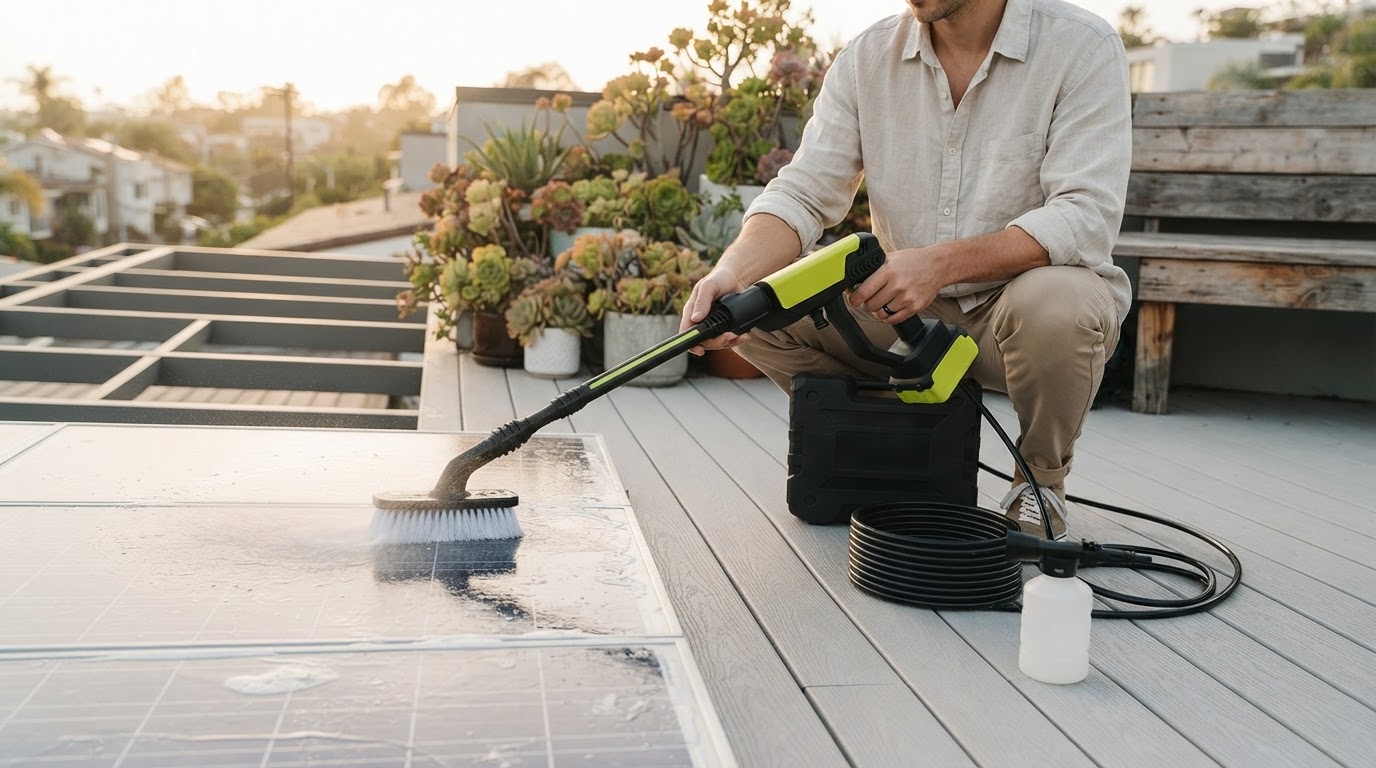
High pressure is not only unnecessary for oil removal but actively dangerous to the structural integrity of the panel. A-R Solar explicitly warns that the force from a high-pressure hose nozzle can damage the seals, wiring, and mounting components of a solar array. Here's the part nobody talks about: oil is hydrophobic, meaning a standard 500 PSI cordless stream will simply bead off the surface rather than lifting the contaminant. To actually strip oily grime, the system requires a chemical surfactant and mechanical agitation. Karcher notes that professional solar cleaning is best achieved using a pressure washer in combination with a brush attachment or roller brush and a telescoping wand. For the average consumer, this means the value of a cordless pressure washer lies in its ability to feed detergent-rich water at a controlled, low-pressure flow to a rotating brush head, rather than relying on raw impact force.
Can cordless units provide enough volume for effective rinsing?
Photo by Tima Miroshnichenko on Pexels
Run the math: a standard cordless pressure washer typically delivers between 0.8 and 1.5 gallons per minute (GPM), which is significantly lower than gas-powered units but sufficient for the delicate rinsing required for solar glass. While some users on Quora question if pressure washing is safe at all, the limiting factor for oil removal is the water temperature and the volume of the rinse. Because oil-based films become more viscous in cold water, a low-GPM cordless unit must be used during the cooler parts of the day to prevent thermal shock to the glass while ensuring the surfactant has enough dwell time to emulsify the oils. I'll change my mind when manufacturers produce a portable unit capable of heating water to 140 degrees Fahrenheit without draining a 4.0Ah battery in three minutes; until then, the cordless washer functions better as a delivery system for cleaning agents than as a physical scraper.
Quick answers
Q: Will a cordless pressure washer void my solar panel warranty? A: Most manufacturers, including those cited by A-R Solar, suggest that high-pressure streams can damage seals, potentially voiding warranties if the pressure exceeds 1,500 PSI. Cordless units typically operate between 300 and 800 PSI, making them a safer choice if used with a wide-angle nozzle.
Q: What is the best way to remove oily soot from panels near a highway? A: Use a cordless pressure washer with a soap-siphoning feature to apply a biodegradable degreaser, followed by a soft-bristle brush scrub. This is similar to the process used for small battery pressure washer for window cleaning, where mechanical contact is prioritized over water force.
Q: How often should oily residues be cleaned to maintain efficiency? A: Data suggests that heavy oily buildup can reduce output by over 20%, necessitating a cleaning every six months. Regular maintenance using a solar panel cleaning pressure washer cordless setup ensures that grime does not bake into the anti-reflective coating.
Learn more about Cordless Pressure Washers at https://cordlesspressurewasher.com.
Sources
Photo by Tima Miroshnichenko on Pexels
- Is it safe to use a pressure washer to clean solar panels?
- Solar and Photovoltaic Panel Cleaning
- Can you pressure wash solar panels?