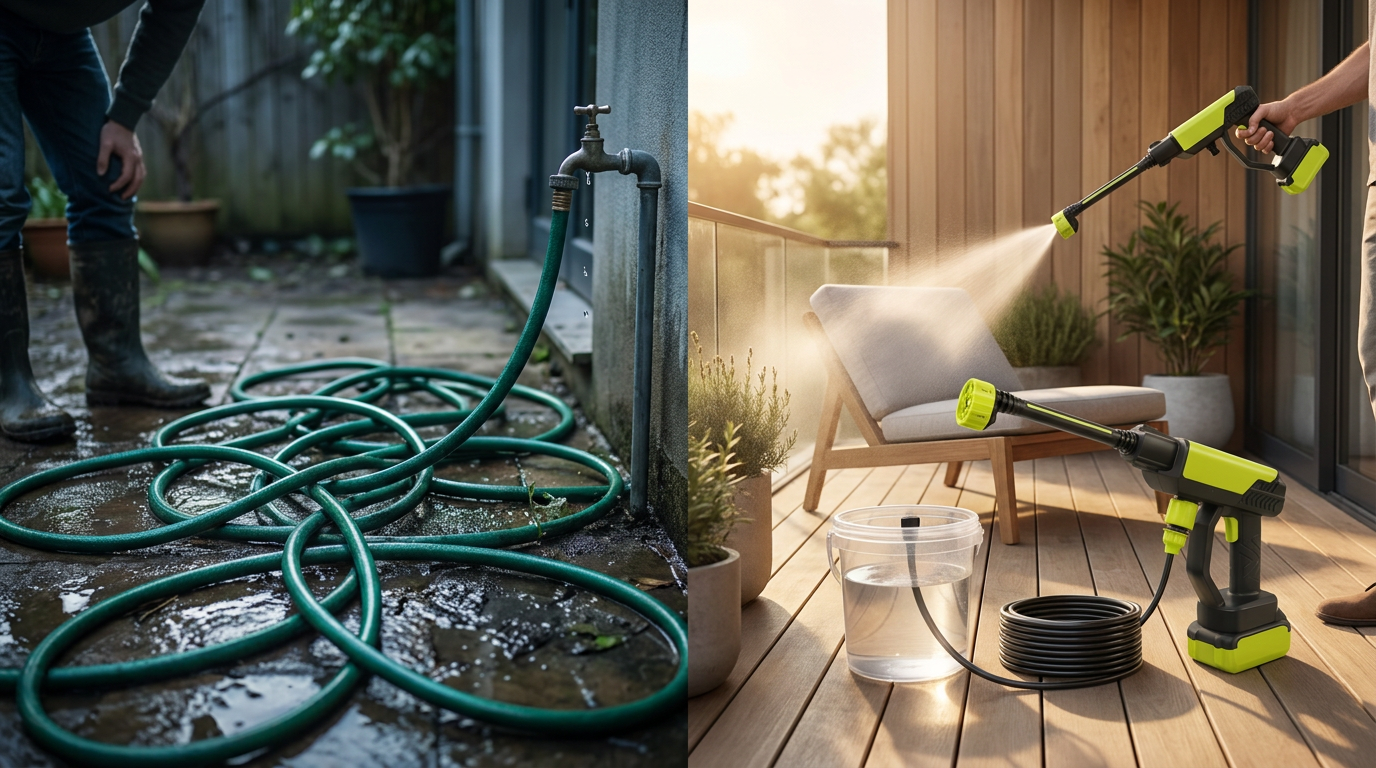
Integrated Tank Systems for Cordless Pressure Washers
 Jordan HaleStaff Writer
May 12, 2026 — The shift toward total portability in the cleaning industry has accelerated the development of Cordless Pressure Washers that bypass the need for a garden hose tether.
Modern consumers are increasingly prioritizing self-contained units for tasks ranging from balcony maintenance to remote vehicle detailing. According to technical specifications from Muc-Off USA, mobile pressure washer units now utilize brushless motors and integrated 20L water tanks to provide consistent pressure without an external supply. This evolution addresses a significant pain point for apartment dwellers and outdoor enthusiasts who lack access to traditional spigots but require more force than a standard garden sprayer can provide.
The Three-Point Portability Framework
Photo by Helena Jankovičová Kováčová on Pexels
When evaluating a cordless pressure washer with an integrated tank, the balance between water volume and physical weight determines the tool's actual utility. A standard 20L (approx. 5.2 gallon) tank provides roughly 15 to 20 minutes of continuous cleaning time depending on the flow rate. For example, the Muc-Off Mobile Pressure Washer delivers up to 942 PSI while drawing from its 20L reservoir, powered by a 40V lithium-ion battery. This specific configuration allows for a boost mode that maximizes output for 15 minutes, which is generally sufficient for cleaning two full-sized bicycles or a muddy mountain bike after a trail ride. Conversely, smaller units like the Velotrex model utilize a 3.4-gallon tank, which reduces the total weight by several pounds, making it more manageable for handheld balcony work. Users must account for the fact that water weighs approximately 8.34 pounds per gallon; therefore, a full 5-gallon tank adds over 40 pounds to the machine's base weight. This physical reality necessitates either high-quality casters or a shoulder strap system to maintain the "portable" promise of these Cordless Pressure Washers. Maintenance also shifts in these self-contained systems, as the internal pumps are more sensitive to sediment than their hose-fed counterparts. Ensuring the longevity of the unit requires strict adherence to filtration standards, particularly when sourcing water from non-potable containers.
Expert tip: To maximize the lifespan of your unit, always prime the pump by letting water flow through the system before engaging the motor, especially when you maintain pressure washers in remote areas where air pockets are more likely to form in the intake line.
Understanding the limitations of your reservoir is vital for successful project completion. If you are planning a longer session, you should identify the best water sources for off-grid pressure washing to ensure you can refill the tank without damaging the internal seals. For those working in isolated locations, knowing how to maintain pressure washers in remote areas ensures that a clogged filter doesn't end your workday prematurely. Selecting the right best water sources for off-grid pressure washing also prevents mineral buildup within the integrated tank’s delicate spray nozzles.
As battery technology continues to improve, the efficiency of these tank-based systems will likely bridge the gap between light-duty rinsing and heavy-duty cleaning.
Shop Cordless Pressure Washers.