
Rapid Battery Drain Diagnostic Path
Is your cordless pressure washer shutting down after just 3 to 5 minutes of work? In over 80% of cases, rapid battery drain is caused by severe pump backpressure from a clogged spray nozzle or an unprimed hose—which forces the motor to draw double the standard electrical current—or by thermal safety cut-offs triggered when hot lithium-ion cells overheat under direct sunlight.
Rapid Battery Drain Diagnostic Path
- Is the battery pack hot to the touch (above 115°F) or showing a flashing error code on the charger? → Yes: Thermal Protection Cut-Off: Let the battery pack rest in a cool, shaded area for 30 minutes before testing or charging.. No: Proceed to check hydraulic pump drag and nozzle restriction..
- Does the motor sound like it is straining under heavy load when you pull the trigger? → Yes: High Amp Draw from Hydraulic Resistance: Clean the nozzle tip orifice with a stainless needle and check the water inlet filter for debris.. No: Proceed to test electrical cell health and resting voltage..
- Does the resting voltage drop rapidly below 15V (for a 20V battery) within 60 seconds of pulling the trigger? → Yes: Lithium Cell Degradation / High Internal Resistance: The pack has reached end-of-life or lost cell balance. Replacement required.. No: System is healthy; verify charger output voltage and ensure full 100% charging cycle completed..
Root Cause Troubleshooting Matrix: Battery Drain Failure Modes

Photo by https://kaboompics.com/ on Pexels
| Failure Mode | Primary Symptom | Root Electrical / Mechanical Cause | Immediate Resolution |
| --- | --- | --- | --- |
| Nozzle Orifice Restriction | Tool shuts off in under 3 minutes; motor pitched higher than normal. | Clogged spray tip forces pump against high backpressure, raising motor current draw by 50–80%. | Clear nozzle orifice with a needle tool and flush with clean fresh water. |
| Thermal Overload Shutdown | Battery LEDs flash; tool cuts out abruptly mid-clean in summer heat. | BMS safety switch interrupts power when internal cell temperatures exceed 140°F (60°C). | Move battery pack to shade; allow 25-30 minutes of passive cooling before reuse. |
| High Pressure Drag / Unprimed Hose | Motor pulses continuously and drains pack rapidly. | Air pockets in suction line create hydraulic turbulence, causing continuous high amp spikes. | Squeeze trigger without pressure nozzle attached to bleed trapped air before washing. |
| Internal Lithium Cell Imbalance | Battery shows 4 full LED lights resting, but dies instantly upon trigger pull. | High internal resistance causes massive voltage drop under load, tripping BMS minimum voltage threshold. | Conduct load test with a multimeter; replace battery pack if voltage drops >25% under load. |
| Parasitic Drain / Corrosion | Battery loses 30% charge sitting on workbench overnight. | Corrosion across terminal contacts creates high-resistance micro-short circuits. | Clean terminal pins with electrical contact cleaner and brush away white powder oxidation. |
Identify the primary failure modes causing short runtimes and learn how to resolve them immediately.
Pro Tip: The Motor Amp-Draw Connection You Might Be Overlooking
When your pressure washer motor works against extra resistance, it doesn't just work harder—it consumes exponentially more electricity. A standard 20V portable pressure washer motor pulls around 12 to 14 Amps under normal conditions (using a 25° or 40° fan nozzle). However, if the tiny orifice on a 0° jet tip or turbo nozzle gets partially blocked by sand or mineral scale, system pressure spikes inside the pump manifold. This backpressure forces the motor to draw 22 to 25 Amps continuously.
At 25 Amps, a standard 2.0Ah battery pack will drain completely in under 5 minutes! Keeping your nozzles clean and ensuring your water source is filtered isn't just about water flow—it is the single best way to protect your battery runtime.
Decision Tree: Repair, Re-balance, or Replace Your Battery?
- Is your battery pack less than 2 years old and kept at room temperature? → Yes: Issue is likely mechanical load or thermal lockout. Check nozzle tips and air leaks.. No: Inspect for permanent cell degradation due to age or winter storage.
- Does cleaning the spray tip and bleeding the hose air restore full 15-20 minute runtime? → Yes: Resolved! System was suffering from hydraulic motor overload.. No: Perform multimeter load testing on battery terminals.
- Does terminal voltage drop significantly when the motor is engaged? → Yes: Internal resistance is elevated. Recast or replace battery pack.. No: Check charger output voltage to ensure full charge cycle is occurring.
Immediate Action Steps for Your Battery
Your decision: Determine whether your battery loss is due to simple mechanical overload (clogged tip/thermal safety) or physical lithium-ion battery degradation.
Do this next: Clean spray tip with needle, flush inlet filter, allow battery to cool to room temperature, and test resting voltage with a multimeter.
- Read next: How to Store Your Cordless Pressure Washer Battery in Winter to Prevent Degradation
- Read next: 2.0Ah vs. 4.0Ah vs. 6.0Ah: Which Battery Capacity Do You Need for Car and Home Cleaning?
Cordless Pressure Washer High-Capacity Battery Packs (4.0Ah / 6.0Ah)
Take these concrete steps right now to diagnose and recover your pressure washer's battery life.
Essential Battery Care & Runtime Preservation Rules
Keep these key takeaways in mind every time you pull out your portable pressure washer:
Pre-Cleaning Battery Health & Prep Checklist
- Verify battery LED indicator shows 100% full charge prior to insertion.
- Inspect nozzle tip for sand, mineral scale, or debris buildup using a needle tool.
- Ensure water supply hose is fully primed and free of kinks or air pockets.
- Confirm battery pack is at room temperature (between 50°F and 80°F) before powering on.
- Check battery terminals for corrosion, debris, or bent connector pins.
Battery Capacity vs. Runtime & Amp-Draw Specification Matrix
| Battery Specs | Nozzle / Operating Pressure | Average Current Draw | Expected Runtime (70°F) | Expected Runtime (95°F Direct Sun) |
| --- | --- | --- | --- | --- |
| 20V 2.0Ah Compact | 40° Wide Fan (Low Drag) | 11.0 Amps | 11–13 Minutes | 7–9 Minutes (Early BMS Cutoff) |
| 20V 2.0Ah Compact | 0° Pin Jet / Turbo (High Drag) | 18.5 Amps | 6–7 Minutes | 4–5 Minutes |
| 20V 4.0Ah Extended | 40° Wide Fan (Low Drag) | 11.5 Amps | 22–25 Minutes | 16–18 Minutes |
| 20V 4.0Ah Extended | 0° Pin Jet / Turbo (High Drag) | 19.0 Amps | 12–14 Minutes | 8–10 Minutes |
| 40V 5.0Ah Heavy Duty | 25° Medium Fan (Standard Drag) | 14.0 Amps | 35–40 Minutes | 28–32 Minutes |
Understand how battery Ah capacity, operating voltage, and nozzle pressure choices directly govern your cleaning runtime in minutes.
Recommended Replacement Batteries & Extended Power Upgrades
If your original battery pack has aged out or you simply need more runtime to finish multi-vehicle washes or patio cleaning, upgrade to these high-performance options.
Seasonal Battery Maintenance and Storage Schedule
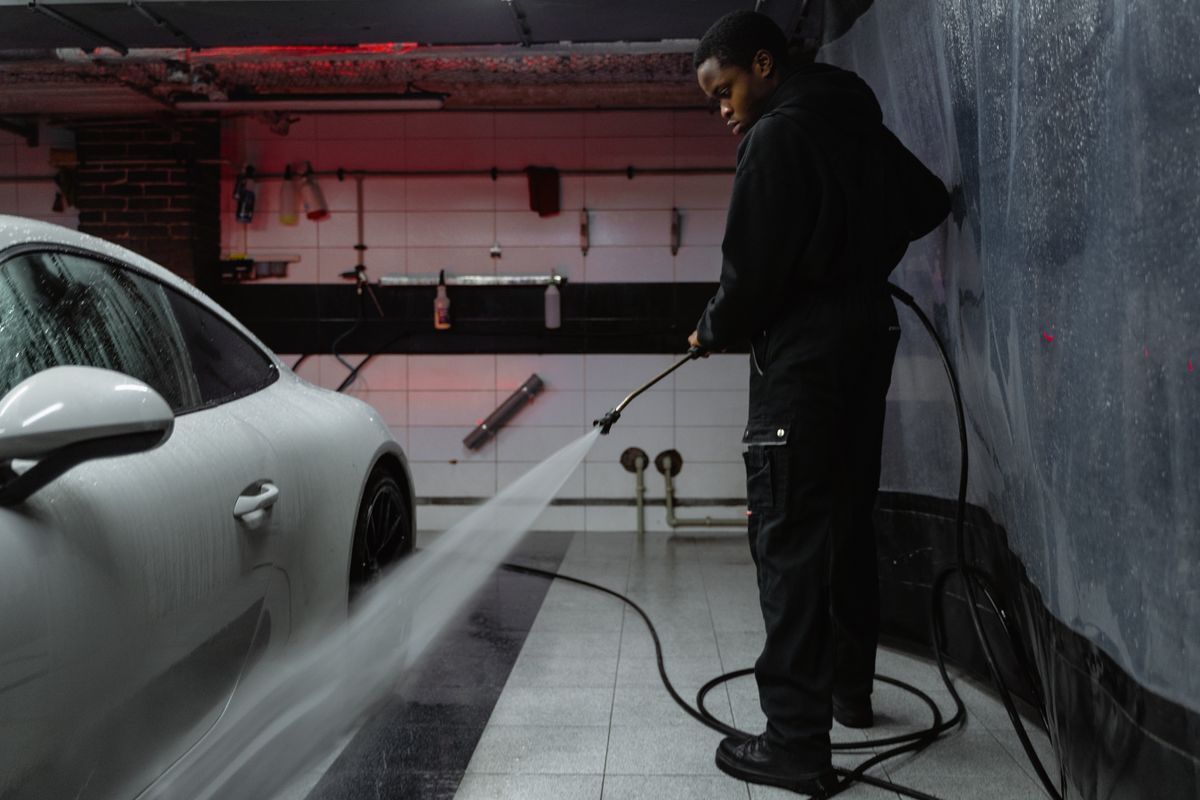
Photo by Tima Miroshnichenko on Pexels
- Before Every Cleaning Session — Check nozzle orifice for clogs; prime water hose to eliminate pump cavitation.
- After Every Cleaning Session — Remove battery pack from tool body; allow pack to cool 20 minutes before charging.
- Monthly During Active Season — Inspect copper battery contacts for oxidation; wipe clean with micro-fiber cloth and isopropyl alcohol.
- Winter Storage Prep — Charge or discharge battery to approximately 50–60% state of charge (2 of 4 LED lights); store indoors between 55°F and 70°F.
- Mid-Winter Storage Check — Check voltage or LED state of charge once every 90 days; top off to 50% if pack self-discharges.
Side-by-Side: Normal Runtime Loss vs. Critical Cell Failure
| Diagnostic Factor | Normal Thermal / Mechanical Stress | Critical Lithium Cell Failure |
| --- | --- | --- |
| Resting Voltage | Measures full nominal voltage (e.g., 20.5V on a 20V pack). | Measures below 16V even after 4 hours on charger. |
| Behavior Under Load | Runs for expected duration once nozzle is unclogged. | Shuts down within 5-15 seconds of trigger pull regardless of nozzle. |
| Temperature Response | Battery warms up moderately (100°F–110°F); cools down and operates normally. | Battery becomes scorching hot (130°F+) almost instantly upon use. |
| Charger Behavior | Charger red light turns solid green after 60-90 minutes. | Charger flashes red/green error code immediately upon inserting pack. |
| Runtime Restoration | Restored by cleaning nozzles, bleeding air, or washing in shade. | Cannot be restored; runtime remains under 2 minutes under all conditions. |
Determine whether your battery's current behavior is a normal symptom of external factors or a sign of permanent internal failure.
Step-by-Step Electrical & Mechanical Diagnostic Test
Follow this step-by-step diagnostic procedure to test your pressure washer system with basic tools at home.
Common Battery Charging and Storage Mistakes to Avoid
Avoid these five common user mistakes that permanently ruin lithium battery capacity and cause unexpected shutdowns:
Frequently Asked Questions About Cordless Pressure Washer Batteries
Clear answers to the most common battery performance questions from portable washer owners.
Final Checklist & Diagnostic Summary
Your decision: Identify if mechanical resistance, overheating, or cell degradation is cutting your cleaning time short.
Do this next: Clean your nozzle tips with a needle tool, bleed intake hose air before powering on, allow warm batteries to cool before charging, and upgrade to a 4.0Ah or 6.0Ah pack if your cleaning jobs require more than 25 continuous minutes.
- Read next: How to Store Your Cordless Pressure Washer Battery in Winter to Prevent Degradation
- Read next: 2.0Ah vs. 4.0Ah vs. 6.0Ah: Which Battery Capacity Do You Need for Car and Home Cleaning?
Cordless Pressure Washer High-Capacity Battery Packs (4.0Ah / 6.0Ah)
Ready to get back to cleaning? Follow our recommended resolution path based on your diagnostic results.