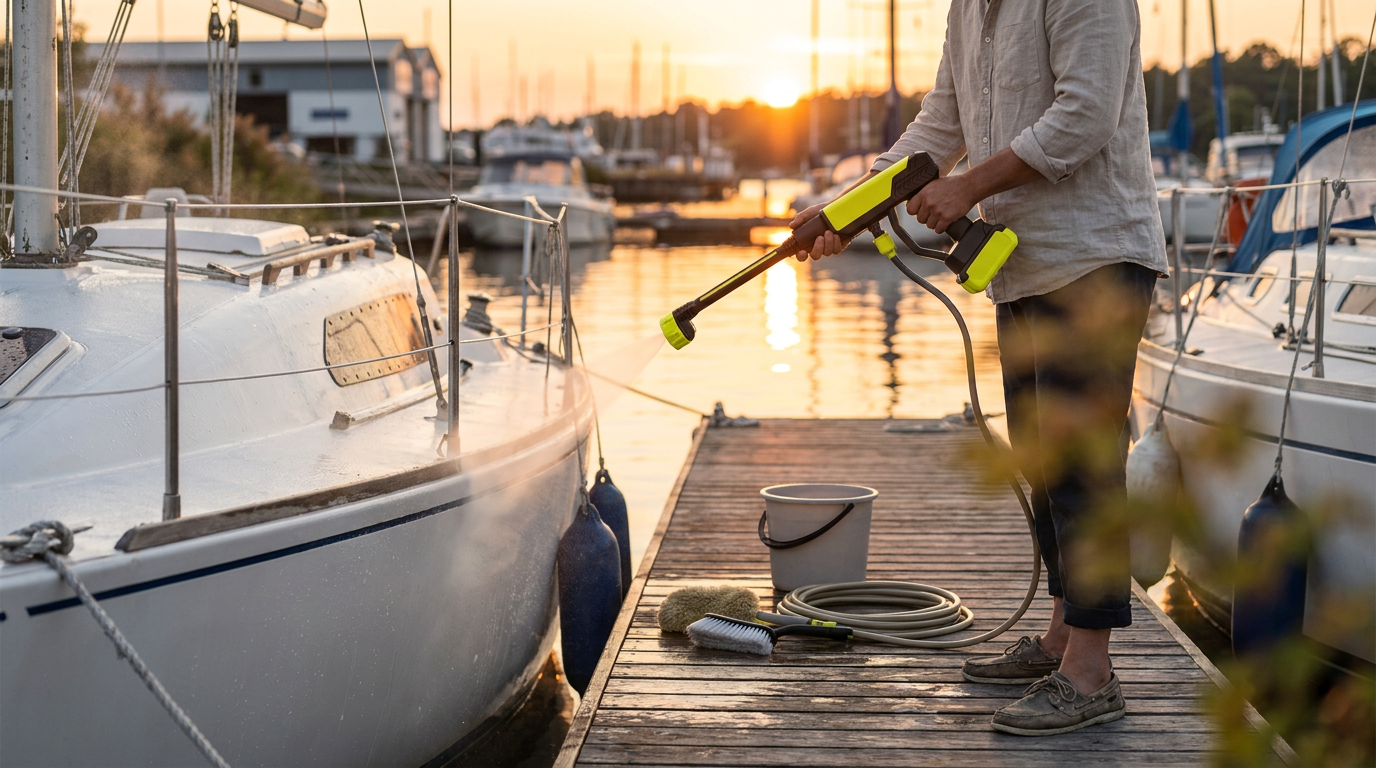
Can Cordless Pressure Washers Clean Boats at the Slip?
 Maya ChenContributing Editor
June 29, 2026 — Cordless Pressure Washers are capable of effectively removing salt spray and light biological growth from boat hulls at the slip, provided the operator utilizes a unit with adjustable pressure settings to avoid delaminating the gel coat.
Boat owners frequently struggle with the logistical bottleneck of moving a vessel to a wash-down station or finding a dock with active power and freshwater hookups. For routine maintenance and slip-side rinses, the mobility of battery-operated systems outweighs the raw power of corded alternatives.
Can Cordless Pressure Washers damage fiberglass or gel coats?
Cordless Pressure Washers will not damage fiberglass or gel coats if kept within the 300 to 800 PSI range, but higher pressures risk structural compromise on older vessels. The mechanical force required to strip salt is significantly lower than that required to strip paint, meaning excessive PSI is often counterproductive. According to reporting by Motor Boat & Yachting (MBY), the best pressure washers for boats must have an adjustable range to protect older gel coats, fiberglass, and wood.
A typical cordless unit operating at 500 PSI provides enough kinetic energy to dislodge surface contaminants without the risk of hydraulic injection into the substrate. While a dock-mounted pressure washer is designed for heavy-duty cleaning, its fixed nature makes it less practical for reaching the awkward angles of a hull while the boat is in the water. Zone discipline matters as much as pressure numbers, because a boat is several materials pretending to be one surface. The wash runs top-down as on any vehicle, but with marine-specific no-fly zones: clear vinyl enclosure windows (isinglass) never meet pressurized water at any setting — micro-scratching and forced water past the stitching ruin panels that cost more than the washer — and canvas, snaps, and zippers all prefer low pressure at generous distance. Around deck hardware, the risk is the caulk line: every cleat, stanchion base, and rail fitting is bedded in sealant, and a tight stream worked at close range along those seams is how a wash becomes a leak. Give hardware a wide-fan pass from a couple of feet and let the brush do the close work. Non-skid decking is the one zone where the washer alone underperforms — the texture that grips shoes also grips dirt, so the effective sequence is a soft-brush scrub with soap, then the wide fan to rinse the loosened grime out of the pattern.
Is it possible to use lake or salt water for boat cleaning?

Photo by Quang Nguyen Vinh on Pexels
It is possible to use Cordless Pressure Washers with raw water sources like lakes or estuaries, provided the unit utilizes a fine-mesh filtration intake to prevent pump cavitation. Power Boating Magazine notes that compact, lightweight cordless nozzles weighing as little as 3.7 lbs can draw water from any remote source, including the body of water the boat is floating in.
However, using salt water for cleaning is a technical error. While pressure removes physical debris, it leaves behind microscopic salt crystals that accelerate corrosion. A better strategy involves using a pressure washer that pulls from a bucket filled with fresh water. This setup allows for a high-quality rinse without requiring a 100-foot hose. The efficacy of these systems is confirmed by field tests from independent reviewers on YouTube's marine maintenance channels, demonstrating that battery-powered washes are sufficient for routine hull maintenance. Slip-side washing also happens inside someone else's rulebook, and it pays to know it before the foam cannon comes out. Marinas commonly restrict in-water hull cleaning and regulate wash-down soaps, because everything rinsed off a boat at the slip goes directly into the water the marina sits on — and in designated no-discharge or environmentally sensitive harbors the rules carry real teeth. The green-boater baseline travels well: phosphate-free, biodegradable marine soaps only, used sparingly; no bottom-scrubbing at the slip that could shed antifouling paint into the water column; and a preference for freshwater rinse-only maintenance between proper washes, which handles salt spray — the main routine enemy — with zero chemical discharge. A two-minute conversation with the dockmaster settles the local rules and often surfaces the marina's own wash-down station schedule. The cordless unit is genuinely the friendliest tool in this environment: its modest flow rate means a full cockpit-and-topsides rinse uses a fraction of the water a dock hose sprays, which dockmasters notice approvingly.
Quick answers
Q: How much does a typical boat-ready cordless pressure washer weigh? A: A standard portable unit, such as those discussed by Power Boating Magazine, weighs approximately 3.7 lbs. without the battery pack, making it manageable for one-handed use.
Q: Can I use these units to clean my mountain bike after a coastal ride? A: Yes, the same low-pressure settings make a portable shower for mountain bikes ideal for removing salt air and mud without forcing water into sealed bearings.
Q: What is the primary risk of using a high-pressure gas washer on a boat? A: The primary risk is the high-velocity stream penetrating the gel coat or stripping caulking from deck hardware, a risk mitigated by the controlled output of cordless units.
Q: Do I need a special attachment for cleaning boat decks? A: Most marine applications benefit from a 4-in-1 or 6-in-1 nozzle that allows for a wide fan spray, covering more surface area and reducing concentrated impact on non-skid surfaces.
Learn more about Cordless Pressure Washers at https://cordlesspressurewasher.com.
Trailer boats: the ramp-side rinse is the whole ballgame
For trailered boats, the cordless washer's killer application is not the slip at all — it is the fifteen minutes at the ramp after haul-out, when the salt is still wet and surrenders easily. The routine: hull and outboard exterior first while still dripping, then the trailer itself, which is the most corrosion-prone object in the entire operation — brakes, wheel hubs, bunks or rollers, and the winch post all bathe in salt water at every launch and are the components that actually fail from skipped rinses. A five-gallon jug of fresh water in the truck bed feeds the washer's suction hose, making the whole ritual independent of whether the ramp offers a hose (many don't, and the queue behind you appreciates speed). Saltwater trips make this non-negotiable after every outing; freshwater lake use relaxes the cadence to periodic, with the trailer brakes still deserving attention after any dunking. The boats that reach ten years looking tired versus the ones that look loved diverge at exactly this habit — not at the annual detail, but at the humble ramp rinse nobody photographs.
Sources
Photo by Tima Miroshnichenko on Pexels