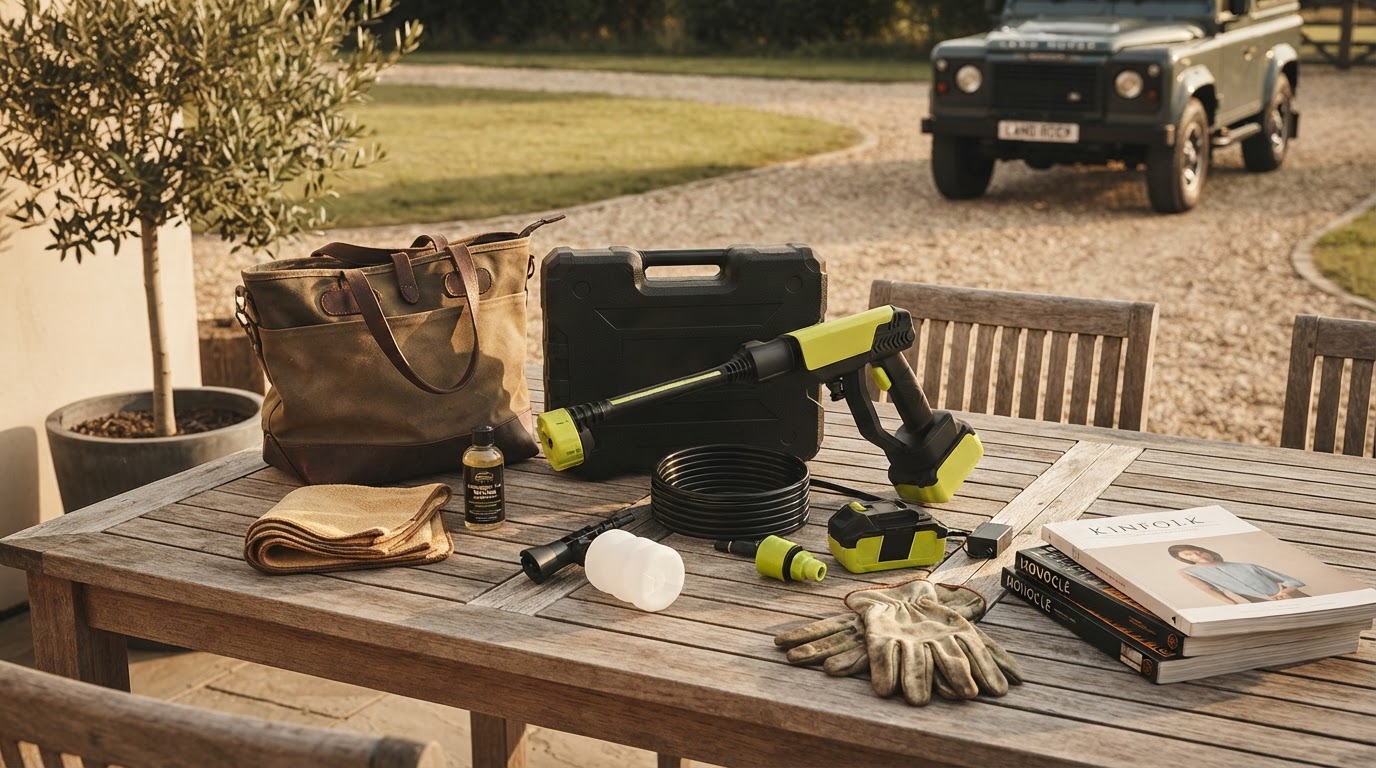
Cordless Pressure Washers with Integrated Water Tanks
 Priya RamanSenior Analyst
October 1, 2026. This analysis examines the technical specifications and utility of cordless pressure washers featuring integrated water tanks. It is intended for property owners and vehicle enthusiasts who require high-pressure cleaning capabilities in environments lacking both electrical outlets and fixed water connections.
The Challenge of Remote Cleaning
Traditional cleaning tasks often face a logistical bottleneck: the requirement for a continuous water supply and a nearby power source. For many users, particularly those living in apartments or maintaining equipment in remote storage facilities, these requirements are impossible to meet. Two axes matter here: the proximity to a pressurized water source and the availability of a 120V electrical outlet. When both are absent, standard equipment fails. This is especially true for tasks like cleaning balcony windows or washing a mountain bike at a trailhead. According to Popular Mechanics, the utility of these devices hinges on their portability, citing models like the Worx WG644 and DeWalt DCPW550P1 as leaders in the handheld category for their ability to function without being tethered to a wall. However, even these units often rely on a siphoning hose, which introduces the need for a separate bucket. The integrated tank model solves this by merging the reservoir and the pump into a single mobile unit, removing the trip hazard of trailing hoses and the instability of open-topped containers. This configuration is essential for users who find that a handheld power washer with bucket draw still lacks the necessary self-containment for rapid, multi-location cleaning tasks.
Technical Capabilities of Tank-Integrated Units
Think of it as a matrix of capacity versus pressure. Integrated tank units are engineered to balance the weight of the water against the power output of the battery. For instance, the Muc-Off Mobile Pressure Washer features a 20L integrated water tank paired with a 500w brushless motor. This setup provides up to 942 PSI, which is significantly higher than entry-level handheld sprayers, while maintaining a runtime of approximately 24 minutes on a 40V lithium-ion battery. The engineering trade-off is clear: by carrying the water on-board, the unit becomes heavier but significantly more stable. Other variations, such as the Velotrex Cordless Portable Pressure Washer, utilize a 3.4-gallon (approximately 12.8L) foldable tank. This design choice prioritizes storage, allowing the unit to collapse when not in use while still delivering 507 PSI. These specifications demonstrate that an electric power washer no outdoor faucet scenario is no longer a limitation for high-performance cleaning. Unlike a pressure washer that runs off a bucket, which requires the user to manage a floating intake filter and a stationary water source, the integrated tank allows for a 360-degree range of motion. This is particularly beneficial for automotive detailing where the user must move around the vehicle constantly. Once you see it this way, the distinction between a simple rechargeable power cleaner for patio use and a professional-grade mobile unit becomes a matter of water volume management.
Framework for Equipment Selection
Selecting the correct hardware requires a synthesis of your specific volume needs and the frequency of your cleaning cycles. The decision rule: if your cleaning task requires more than 15 minutes of continuous spray or involves moving across uneven terrain where a bucket would spill, an integrated tank is the superior choice. For lighter tasks, a handheld pressure washer gun may suffice, but for heavy mud or large surface areas, the stability of a tank-based system is required. When evaluating these units, prioritize the following criteria:
- Motor Efficiency: Look for brushless motors, such as the 500w versions found in Muc-Off units, which offer better longevity and battery optimization.
- Tank Volume vs. Weight: Determine if you can comfortably maneuver a unit containing 20 liters of water (approx. 44 lbs) or if a smaller 3.4-gallon foldable tank is more appropriate for your physical strength.
- Pressure Settings: Ensure the device offers variable pressure modes, such as a "Boost Mode," to handle stubborn grime without depleting the battery prematurely.
- Hose Length: Even with an integrated tank, a 20ft to 23ft hose is necessary to reach the top of vehicles or high windows without moving the base unit.
- Battery Ecosystem: Check if the battery voltage (e.g., 40V vs 18V) aligns with other tools you own to ensure you have back-up power for longer sessions.
Shop Cordless Pressure Washers here